AI OVERVIEW
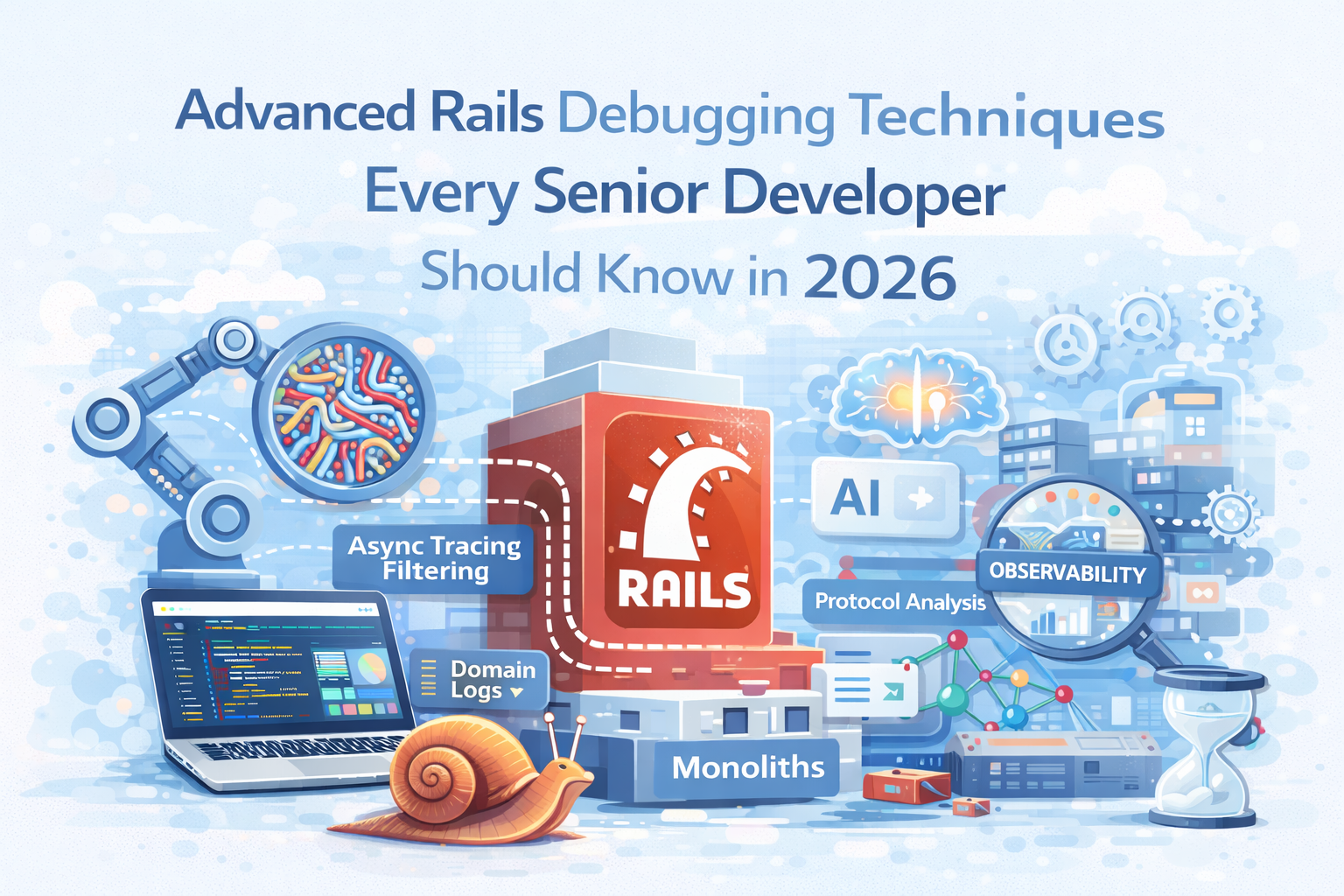
In 2026, advanced Rails debugging goes far beyond byebug and log inspection. Senior developers now rely on production-safe observability, async tracing, domain-level logging, AI-assisted debugging, and protocol-aware analysis—especially in systems integrated with artificial intelligence services, Google ADK Development Services, and modern A2A communication layers. Teams led by Ruby on Rails experts and A2A Protocol experts use proactive debugging strategies to detect performance bottlenecks, concurrency issues, and data inconsistencies before they impact users.
Introduction
As Rails applications grow more complex in 2026, debugging has evolved into a strategic engineering discipline, not just a reactive task. Senior developers are expected to debug production issues involving background jobs, AI pipelines, third-party protocols, and distributed dependencies—often without direct access to failing states.
Traditional Rails debugging techniques fall short when systems involve asynchronous execution, protocol-based communication, or AI-driven workflows. This is why modern Ruby on Rails experts focus on observability-first debugging strategies that scale with system complexity and team size.
This guide explores advanced Rails debugging techniques every senior developer should master in 2026.
What Is Advanced Rails Debugging?
Advanced Rails debugging refers to the practice of system-level problem diagnosis across application code, background jobs, infrastructure signals, and external integrations—without disrupting live users.
Unlike basic debugging, it emphasizes:
- Root-cause analysis instead of symptom fixes
- Production-safe introspection
- Cross-layer visibility (code, data, async, AI services)
- Preventive detection rather than reactive firefighting
Leading Ruby on Rails consulting companies treat debugging as part of system design, not an afterthought.
Why Advanced Rails Debugging Is Important in 2026
Rails systems today are deeply interconnected with AI services, event pipelines, and protocol-based APIs.
Key reasons debugging matters more than ever:
- AI inference failures are harder to reproduce locally
- Async workflows hide execution context
- A2A protocol interactions introduce state ambiguity
- Performance regressions impact revenue directly
- Compliance requires audit-ready debugging trails
- Mean Time to Resolution (MTTR) is a business metric
Senior Rails engineers who master debugging deliver stability, trust, and scalability.
Latest Trends & Innovations in Rails Debugging
Modern Rails debugging reflects broader platform evolution.
Key trends shaping debugging in 2026:
- AI-assisted log analysis and anomaly detection
- Distributed tracing inside monoliths
- Domain-event introspection
- Protocol-aware request inspection
- Debugging at the business-rule level
These innovations are increasingly adopted by teams working with artificial intelligence services and Google ADK Development Services.
Observability-First Debugging in Rails
Logs alone are no longer sufficient.
Advanced Rails teams implement observability as a debugging primitive, not a monitoring add-on.
Core observability components:
- Structured, context-rich logging
- Request and job correlation IDs
- Domain-specific metrics
- Error budgets tied to features
- Traceable async execution paths
Debugging Async & Background Job Systems
Background jobs now power billing, AI inference, notifications, and data pipelines.
Advanced debugging techniques include:
- Capturing job arguments with versioned schemas
- Logging job lifecycle transitions
- Tracking retries with semantic context
- Differentiating transient vs systemic failures
Senior Ruby on Rails experts treat background jobs as first-class production systems, not side utilities.
Debugging AI-Integrated Rails Applications
AI introduces non-deterministic behavior that traditional debugging cannot explain.
Best practices for AI debugging:
- Log prompts, inputs, and response metadata
- Capture model version and inference latency
- Isolate AI failures from core business logic
- Use replayable inference contexts
This approach is critical when Rails is integrated with artificial intelligence services or Google ADK Development Services.
A2A Protocol Debugging in Rails Systems
Application-to-Application (A2A) protocols have become a foundational layer in modern Rails-based ecosystems, enabling secure, high-throughput communication between internal services, AI platforms, and third-party systems.
Advanced A2A debugging strategies include:
- Protocol-level request and payload validation
- State transition and message lifecycle logging
- Idempotency key tracking across distributed requests
- Timeout behavior analysis and retry-flow visualization
This is where partnering with an experienced A2A protocol software development company becomes critical.
Debugging Data Integrity & Consistency Issues
Most production bugs are data bugs, not code bugs.
Advanced data debugging techniques:
- Temporal data snapshots
- Versioned write paths
- Read/write separation tracing
- Invariant-based validation checks
Senior Rails developers debug state transitions, not just failing methods.
Benefits of Advanced Rails Debugging for Businesses
Advanced debugging directly impacts business outcomes.
Key benefits include:
- Reduced production downtime
- Faster incident resolution
- Improved customer trust
- Lower operational costs
- Higher developer confidence
- Better AI system reliability
This is why enterprises rely on seasoned Ruby on Rails consulting companies.
Common Mistakes to Avoid
Even experienced developers make avoidable debugging mistakes.
Common pitfalls:
- Debugging only at the code level
- Over-reliance on production console access
- Ignoring async execution context
- Logging too much or too little
- Treating AI errors as black boxes
Avoiding these mistakes separates senior developers from mid-level engineers.
Expert Tips & Best Practices
Advanced debugging is a mindset as much as a skill.
Proven best practices:
- Design features with debuggability in mind
- Log business intent, not just execution steps
- Standardize error taxonomies
- Add observability before scaling traffic
- Review incidents as learning systems
Conclusion: Debugging as a Competitive Advantage
In 2026, debugging is no longer a reactive task—it is a core capability of high-performing engineering teams. Rails developers who master advanced debugging techniques gain deeper system understanding, reduce risk in AI-integrated workflows, and deliver more resilient applications at scale. Organizations working with a forward-thinking Ruby on Rails consulting company and seasoned Ruby on Rails experts, such as W3villa Technologies, position themselves to build stable, intelligent, and future-ready platforms powered by modern Rails architecture.
Frequently Asked Questions (FAQs)
1. Is traditional Rails debugging still relevant in 2026?
Yes, but it must be combined with observability, tracing, and async-aware techniques.
2. How does AI change Rails debugging?
AI introduces non-determinism, requiring prompt logging, inference tracing, and version control.
3. What role do A2A protocols play in debugging?
They require protocol-level inspection beyond standard HTTP debugging.
4. Can Rails monoliths support advanced debugging?
Absolutely. Monoliths simplify tracing and state visibility when designed correctly.
5. Do Ruby on Rails consulting companies provide debugging audits?
Yes. Many offer observability reviews, incident analysis, and debugging frameworks.