AI OVERVIEW
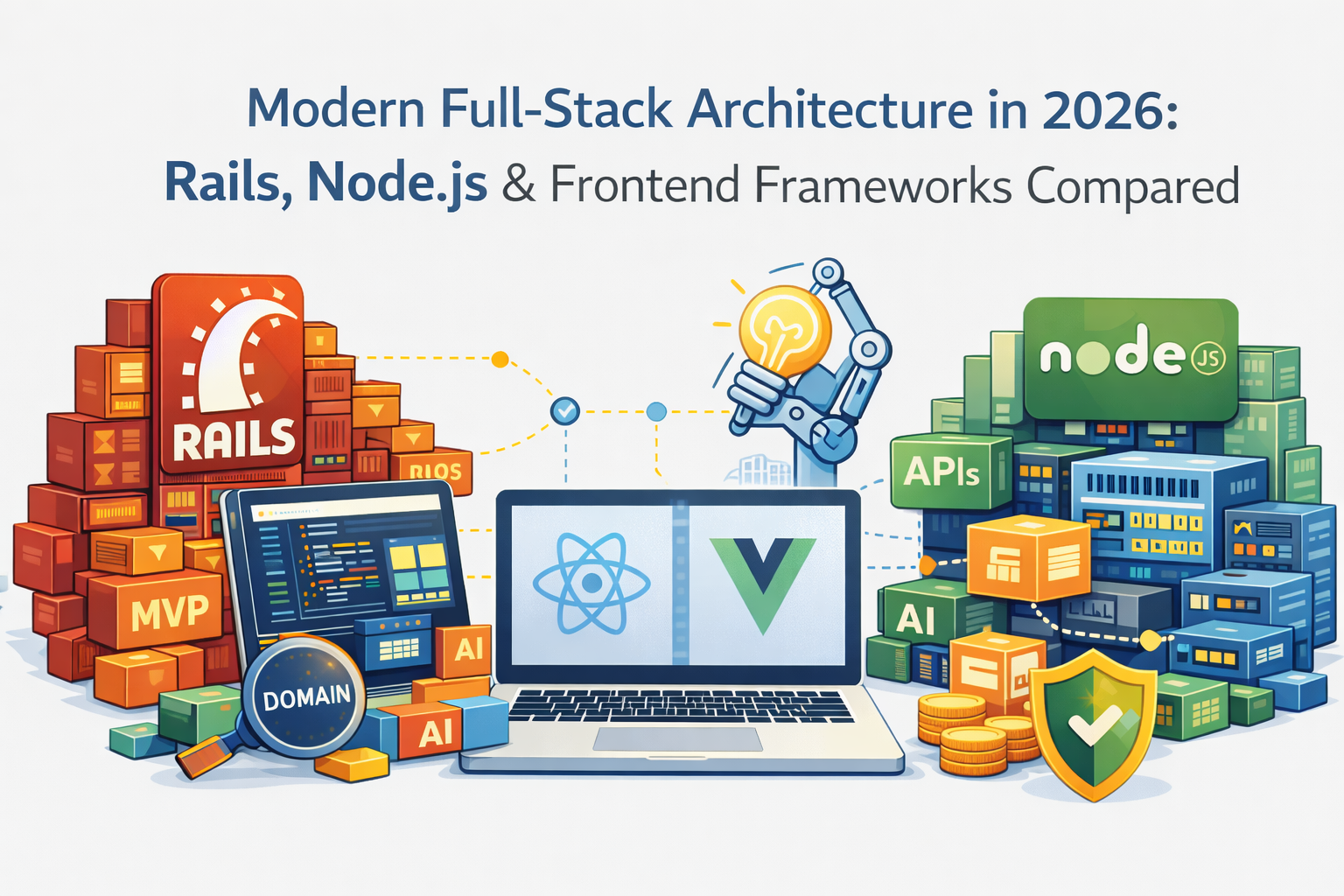
In 2026, modern full-stack architecture is defined by flexibility, scalability, and speed to market. Businesses increasingly combine Ruby on Rails, NodeJS development, and modern frontend frameworks to build scalable MVPs, AI-powered platforms, and enterprise-grade products. Rails excels in rapid backend development and MVP creation, Node.js dominates real-time and API-first systems, while frontend frameworks like React and Vue drive rich user experiences. Choosing the right stack depends on product goals, team expertise, and long-term scalability—not trends alone.
Introduction
Choosing the right full-stack architecture has become one of the most critical technical decisions in 2026. Businesses are no longer building simple CRUD applications; they are creating AI-enabled platforms, API-driven ecosystems, and highly interactive user experiences.
Founders and CTOs often face the same question: Should we use Ruby on Rails, Node.js, or a hybrid full-stack approach with modern frontend frameworks? The answer depends on how well each technology aligns with mvp development, scalability goals, and long-term maintainability.
This blog breaks down modern full-stack architecture in 2026, comparing Rails, Node.js, and frontend frameworks from a practical, experience-driven perspective.
What Is Modern Full-Stack Architecture?
Modern full-stack architecture refers to the end-to-end design of backend systems, APIs, databases, and frontend interfaces working together as a cohesive product.
In 2026, a full-stack system typically includes:
- A backend framework (Rails or Node.js)
- API development services for integrations
- A modern frontend framework
- Cloud-native infrastructure
- AI and automation layers
Experienced ruby on rails experts design full-stack systems with long-term scalability in mind, not just initial speed.
Why Modern Full-Stack Architecture Is Important in 2026
In 2026, full-stack architecture decisions directly impact product speed, scalability, and business success. Faster MVP validation reduces market risk, AI features require flexible backend systems, API-first design enables multi-platform products, and frontend performance influences user retention. This is why companies thoughtfully compare Ruby on Rails MVP development and NodeJS development, focusing on long-term value rather than short-term technology trends.
Rails vs Node.js: Backend Architecture Comparison
Both Rails and Node.js remain dominant backend technologies, but they serve different strengths.
Ruby on Rails in Modern Architecture
Rails is optimized for product speed, clarity, and convention-based development.
It is widely used for:
- MVP development
- SaaS platforms
- Internal tools
- Business-logic-heavy applications
Ruby on Rails experts value Rails for its opinionated structure and developer productivity.
NodeJS Development in Modern Architecture
Node.js excels in event-driven, real-time, and API-intensive systems.
Common Node.js use cases include:
- Real-time applications
- Streaming platforms
- Microservice ecosystems
- High-concurrency APIs
NodeJS development is often chosen when non-blocking I/O and real-time communication are core requirements.
Role of Frontend Frameworks in 2026
Frontend frameworks are no longer optional layers.
- React for component-driven UIs
- Vue for lightweight interactive interfaces
- Next.js for SEO-friendly applications
Modern full-stack systems separate frontend and backend concerns while maintaining tight integration through API development services.
Latest Trends & Innovations in Full-Stack Architecture
- API-first and headless architectures
- Rails backends with React or Vue frontends
- Node.js for real-time services alongside Rails
- AI-powered backend workflows
- Cloud-native deployment pipelines
Many teams now adopt hybrid architectures, combining Rails for core business logic and Node.js for specialized workloads.
Full-Stack Architecture for MVP Development
In early-stage product validation, development speed and architectural clarity are critical. Ruby on Rails remains a preferred choice for MVP development due to its ability to accelerate feature delivery, reduce initial development costs, maintain a clean and organized codebase, and support rapid iteration. For these reasons, many startups strategically hire Ruby on Rails developers to build scalable MVPs efficiently before evolving their architecture in line with business growth and technical requirements.
Full-Stack Architecture & Artificial Intelligence Services
AI has reshaped backend responsibilities.
- AI inference pipelines
- Data-intensive queries
- Background processing
- Secure API integrations
Rails handles AI orchestration and business logic well, while Node.js often manages streaming or real-time AI interactions. This combination is increasingly common in artificial intelligence services.
Benefits of a Well-Designed Full-Stack Architecture
- Faster product launches
- Lower maintenance overhead
- Easier scaling and refactoring
- Better developer onboarding
- Improved user experience
This is why experienced ruby on rails experts emphasize architectural planning from day one.
Common Mistakes to Avoid
- Choosing technology based on hype
- Over-engineering MVPs
- Ignoring API design consistency
- Mixing frontend and backend concerns
- Scaling infrastructure before validating demand
Avoiding these mistakes saves time, money, and engineering effort.
Expert Tips & Best Practices
- Choose Rails for domain-heavy MVPs
- Use Node.js selectively for real-time needs
- Design APIs before frontend implementation
- Keep AI logic decoupled from UI
- Optimize for team productivity, not just performance
Conclusion: Choosing the Right Stack for the Right Reason
In 2026, modern full-stack architecture is not about choosing between Rails and Node.js—it is about aligning technology with business intent. Rails continues to lead in MVP development and business-logic-driven platforms, while NodeJS development excels in real-time and event-driven systems. When combined with modern frontend frameworks and scalable API development services, both technologies deliver powerful results. Partnering with experienced ruby on rails experts and a forward-thinking technology partner like W3villa Technologies enables businesses to design full-stack systems that scale intelligently, integrate AI seamlessly, and evolve with confidence.