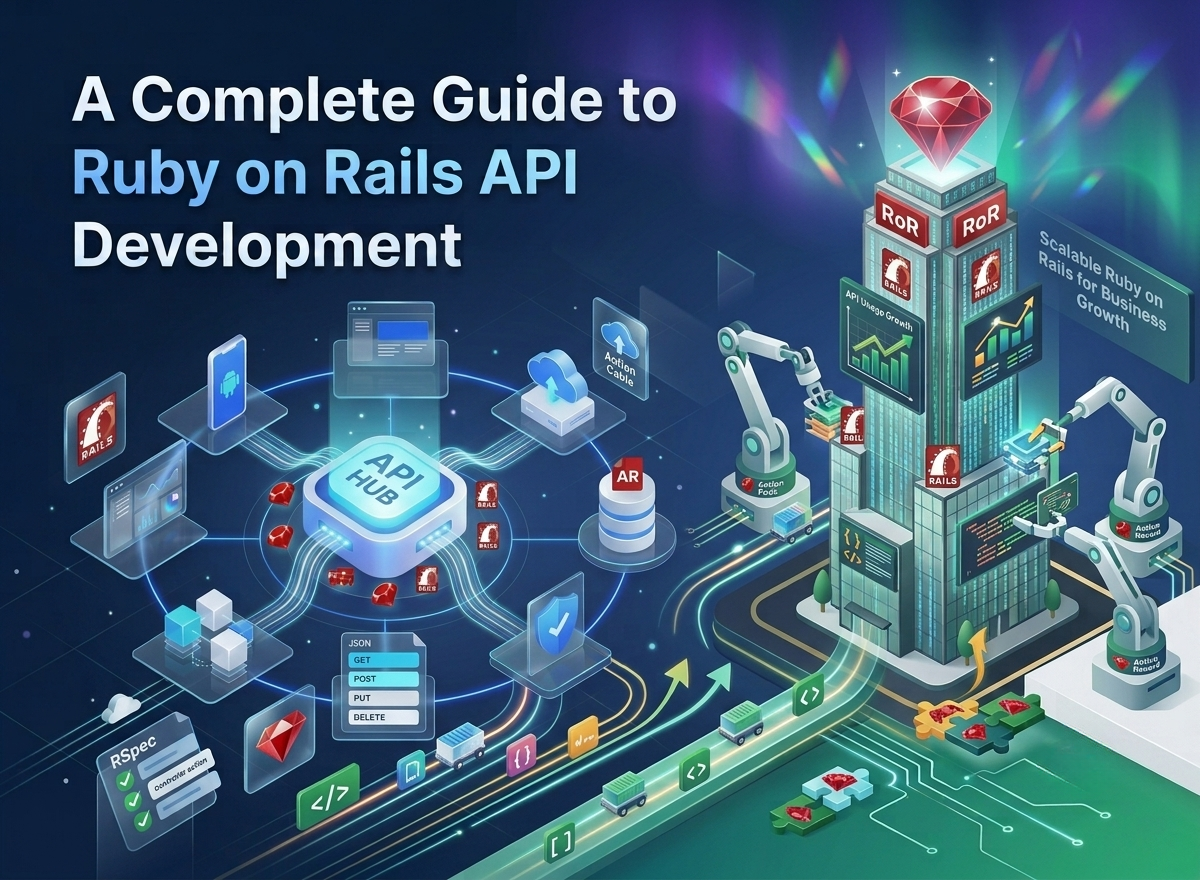
Ruby on Rails has long been a favorite framework for building web applications, and its API mode makes it an excellent choice for creating fast, scalable, and maintainable APIs. Whether you are building a backend for a mobile app, a single page application, or a microservice architecture, Rails offers the tools and conventions needed to get a production ready API up and running quickly. Choosing Ruby on Rails for API Development allows teams to ship reliable products faster while keeping the codebase clean and maintainable.
At W3villa Technologies, a full service software development company, we have helped numerous businesses design, build, and scale Rails based APIs that power their web and mobile applications. In this guide, we will walk through everything you need to know about Ruby on Rails API development, from setup to deployment.
What is Ruby on Rails API Mode?
Rails API mode is a lightweight version of the full Rails framework designed specifically for building APIs. Introduced in Rails 5, this mode strips away components meant for rendering HTML views, such as asset pipelines and view templates, leaving behind a leaner stack optimized for JSON responses. This makes applications faster to boot, easier to maintain, and better suited for modern architectures where the frontend and backend are decoupled.
To create a new Rails API application, you simply run:
rails new my_api --api
This command generates a project structure tailored for API development, excluding unnecessary middleware and view related files.
Why Choose Rails for API Development?
Rails follows the convention over configuration philosophy, which means developers spend less time making basic decisions and more time building actual features. Some of the key benefits of using Rails for API development include:
- Rapid Development: Rails generators and scaffolding tools allow developers to create models, controllers, and routes in seconds.
- Mature Ecosystem: With thousands of gems available, Rails developers can quickly add functionality like authentication, pagination, and background job processing.
- Strong Community Support: Rails has been around for nearly two decades, so documentation, tutorials, and community forums are abundant.
- Built-in Security Features: Rails includes protections against common vulnerabilities such as SQL injection and cross site scripting.
- ActiveRecord ORM: Rails' object relational mapping tool simplifies database interactions, making it easy to work with complex queries and relationships.
Setting Up Your Rails API Project
Once you have created your project using the --api flag, the next step is to configure your database and set up your models. Rails supports multiple databases including PostgreSQL, MySQL, and SQLite. For production applications, PostgreSQL is generally recommended due to its robustness and support for advanced data types.
After configuring the database, you can generate models and controllers using Rails generators:
rails generate model Product name:string price:decimal
rails generate controller Products
These commands automatically create migration files, model classes, and controller skeletons, saving significant development time.
rails generate model Product name:string price:decimal
rails generate controller Products
Building RESTful Endpoints
Rails encourages RESTful design by default. Using the resources method in your routes file, you can quickly define standard CRUD endpoints:
resources :products
This single line generates routes for index, show, create, update, and destroy actions. Inside your controller, you then define the corresponding methods to handle requests and return JSON responses. Rails makes this simple with the render json: method, which serializes Ruby objects into JSON format automatically.
Serialization and Response Formatting
As your API grows, you will likely need more control over how data is formatted before being sent to clients. This is where serializers come in. Gems like Active Model Serializers or the newer JSONAPI Serializer help structure your JSON output consistently, allowing you to include or exclude specific attributes, add relationships, and follow standards like JSON:API specification.
Well structured serialization not only improves consistency across endpoints but also makes your API easier for frontend developers to consume.
Authentication and Authorization
Most production APIs require some form of authentication. Popular approaches for Rails APIs include:
- Token based authentication using gems like Devise combined with Devise JWT
- OAuth2 for third party integrations, often implemented with the Doorkeeper gem
- JWT (JSON Web Tokens) for stateless authentication, which pairs well with API only applications
For authorization, gems such as Pundit or CanCanCan allow you to define fine grained permissions, ensuring users can only access resources they are authorized to view or modify.
Error Handling and Validation
A well designed API should return clear, consistent error messages. Rails allows you to rescue exceptions globally using rescue_from in your application controller, ensuring that errors are caught and formatted properly before being sent to the client. Combining this with ActiveRecord validations ensures that invalid data never reaches your database, and clients receive meaningful feedback about what went wrong.
Testing Your API
Testing is a critical part of API development. Rails integrates seamlessly with testing frameworks like RSpec and Minitest. Request specs are particularly useful for API testing, as they simulate real HTTP requests and verify that your endpoints return the correct status codes, headers, and JSON structure. Automated testing helps catch bugs early and gives you confidence when refactoring or adding new features.
Performance Optimization
As your API scales, performance becomes increasingly important. Some best practices include:
- Using database indexing to speed up query performance
- Implementing caching strategies with tools like Redis
- Avoiding N+1 queries by using ActiveRecord's includes method
- Paginating large data sets using gems like Kaminari or Pagy
- Monitoring performance with tools like New Relic or Scout APM
Deploying Your Rails API
Once your API is ready, deployment options include platforms like Heroku, Render, AWS, or DigitalOcean. Containerizing your application with Docker is also a popular approach, especially for teams working with microservices or Kubernetes based infrastructure. Regardless of platform, make sure to configure environment variables securely, enable HTTPS, and set up proper logging and monitoring for production environments.
Conclusion
Ruby on Rails remains a powerful and efficient choice for API development, thanks to its convention driven approach, rich ecosystem, and strong community support. By following best practices around routing, serialization, authentication, and testing, you can build APIs that are secure, scalable, and easy to maintain. Whether you are building a small internal tool or a large scale public API, Rails provides the flexibility and structure needed to bring your project to life quickly and reliably.
If you are just getting started, the best approach is to build a small project, experiment with different gems, and gradually incorporate more advanced practices like caching and background job processing as your application grows.
If you are looking for expert guidance, W3villa Technologies, a trusted software development company, specializes in Ruby on Rails for API development and can help you design, build, and scale a robust API tailored to your business needs. Get in touch with our team to turn your idea into a production ready API.