AI Overview
High performance Ruby on Rails focuses on optimizing applications through caching, background jobs, and queue systems. These techniques help reduce response time, manage heavy workloads, and support scalable growth efficiently.
Performance plays a crucial role in modern web applications, especially as traffic and system complexity increase. Poor performance can negatively impact user experience and scalability. Teams like W3Villa Technologies focus on building performance-oriented systems that deliver fast response times while efficiently managing workloads, ensuring long-term stability and reliability.
Request Path Optimization: Keeping Responses Fast
The request lifecycle is the most sensitive part of any Rails application. Any unnecessary processing in this path directly impacts response time.
Experienced ruby on rails experts ensure that only essential logic runs during a request, while heavier operations are shifted outside this cycle.
Optimization Focus Areas:
- Minimizing database interactions
- Simplifying controller logic
- Avoiding synchronous heavy tasks
By keeping the request path clean, applications can deliver consistent and fast responses.
Caching Architecture: Reducing System Load
Caching is one of the most effective ways to improve performance by eliminating repeated computations and database queries.
A reliable ruby on rails consulting company implements caching strategies that balance performance with data freshness.
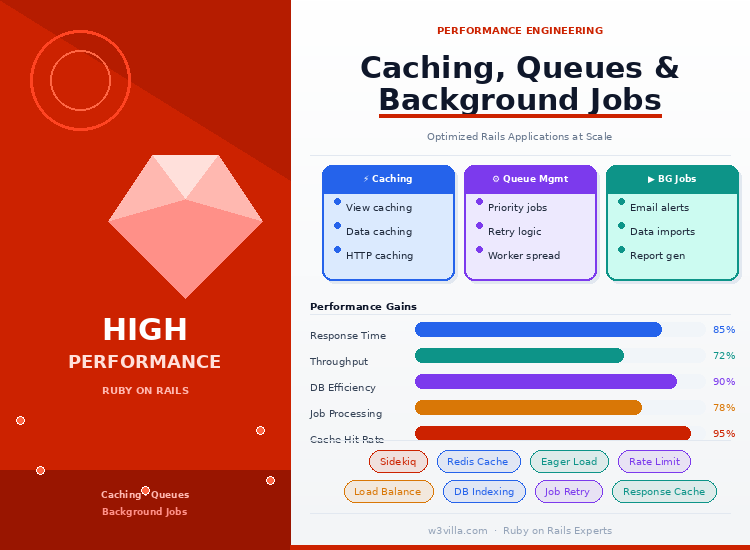
Caching Layers in Rails:
- View level caching for UI components
- Data caching for frequently accessed records
- HTTP caching for faster client responses
Effective caching reduces load on the system and significantly improves speed.
Background Job Execution: Handling Heavy Processes
Heavy operations can slow down an application if handled within the request cycle. Background jobs allow these tasks to be processed asynchronously.
Many businesses work with ruby on rails developers for hire to implement background job systems that improve responsiveness.
Tasks Suitable for Background Jobs:
- Email and notification processing
- Data imports and exports
- Report generation
This separation ensures that user facing operations remain fast while complex tasks run independently.
Queue Management: Structuring Task Processing
Queues are essential for managing how background jobs are executed. They ensure that tasks are processed in a controlled and efficient manner.
A well designed queue system provides:
- Organized task execution
- Controlled workload distribution
- Stability during traffic spikes
Queue Best Practices:
- Prioritize critical jobs
- Implement retry mechanisms
- Distribute load across workers
Proper queue management helps maintain system performance under load.
Database Efficiency: Optimizing Data Access
Database performance directly impacts application speed. Inefficient queries can slow down even the most optimized systems.
A professional ruby on rails consulting company focuses on improving data access patterns to ensure fast and efficient operations.
Optimization Techniques:
- Indexing important fields
- Reducing redundant queries
- Using eager loading for associations
Efficient database usage allows applications to handle large datasets without performance issues.
Load Handling and Resource Management
As traffic grows, efficient resource utilization becomes essential. Poor load handling can lead to system crashes or slowdowns.
With the support of ruby on rails experts, applications are designed to distribute workload effectively across available resources.
Key Practices:
- Load balancing across servers
- Managing worker processes
- Monitoring resource usage
This ensures that the application remains stable even during high demand.
Identifying Bottlenecks and Improving Performance
Performance bottlenecks can appear over time as applications evolve. Identifying and resolving these issues is critical for maintaining efficiency.
Common bottlenecks include:
- Slow database queries
- Blocking operations
- Inefficient background processing
Improvement Strategies:
- Introduce caching where needed
- Move heavy tasks to background jobs
- Optimize queries and indexing
Continuous optimization helps maintain long term performance.
Practical Impact on Application Performance
High performance strategies directly improve how applications behave in production environments. Systems become faster, more stable, and capable of handling growth.
Applications benefit from:
- Faster response times
- Improved scalability
- Better user experience
Teams working with ruby on rails developers for hire often implement these strategies to ensure consistent performance under load.
Conclusion
High performance Ruby on Rails applications rely on efficient caching, background jobs, and queue management to deliver fast and reliable performance.
By optimizing request handling and managing workloads effectively, systems can scale without compromising speed.
Contact us to build Rails applications that are optimized for performance and long term scalability.