AI Overview
Artificial Intelligence is increasingly supporting MVP development by enabling faster decision-making and smarter product validation. AI tools can help analyze user behavior, automate testing, and provide insights that guide feature improvements.
When combined with Ruby on Rails, AI can enhance scalability planning, optimize performance, and accelerate development workflows. This allows businesses to build more efficient MVPs and adapt quickly based on real-time data and user feedback.
Introduction
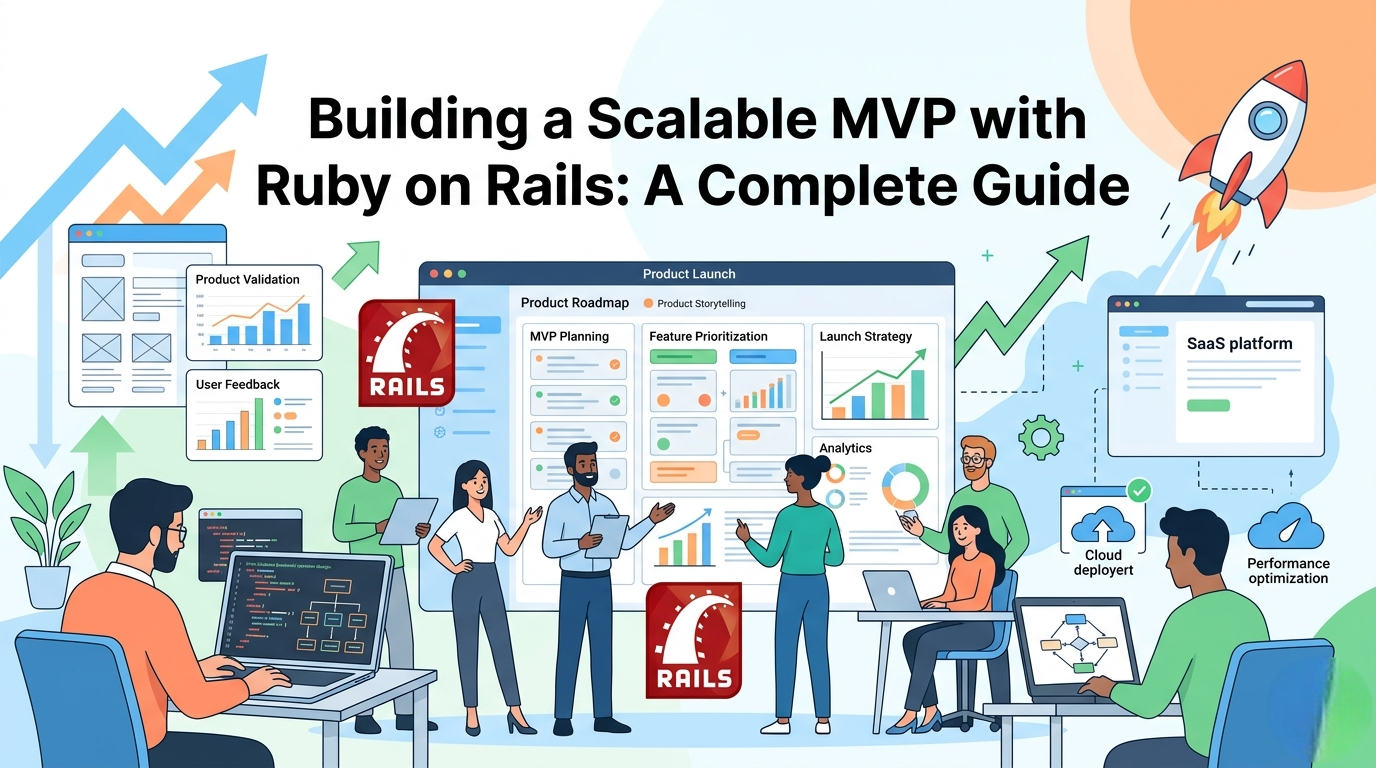
Building a Minimum Viable Product (MVP) is a strategic approach for startups and businesses to validate their ideas quickly with minimal investment. Instead of developing a full-featured product, an MVP focuses on delivering only the core functionality required to solve a specific problem.
Ruby on Rails is widely recognized as one of the most efficient frameworks for MVP development. Its convention-driven structure, built-in tools, and rapid development capabilities make it ideal for launching scalable applications within a short timeframe.
Why Ruby on Rails is Ideal for MVP Development
Ruby on Rails is designed to maximize development efficiency while maintaining code quality. It enables teams to build functional applications faster compared to many other frameworks.
Many startups prefer ruby on rails mvp development because it allows rapid prototyping while keeping the architecture clean and scalable.
- Rapid development with pre-built components
- Cost efficiency due to faster delivery
- Strong ecosystem of reusable libraries
- Maintainable and structured codebase
- Scalability for future growth
Defining the Core MVP Scope
The success of any mvp development process depends on how clearly the core features are defined. The goal is to solve a single primary problem effectively rather than building multiple features at once.
Important considerations:
- Identify the main user problem
- Focus only on essential features
- Avoid unnecessary complexity
- Ensure a smooth user experience
Designing a Scalable Architecture
Even for an MVP, scalability should be considered from the beginning. A well-planned architecture reduces the need for major changes as the application grows.
Key practices include:
- Using modular and clean code structure.
- Following MVC architecture principles.
- Designing a scalable database schema
- Separating business logic properly
This approach ensures long-term maintainability and performance.
Leveraging Rails Ecosystem for Faster Development
Ruby on Rails offers a powerful ecosystem of gems that help accelerate development. These tools reduce the need for custom coding and improve overall efficiency.
Common functionalities that can be implemented quickly:
- User authentication and authorization
- Background job processing
- API integrations
- Pagination and data handling
Using proven tools helps maintain stability and speeds up development.
Performance Optimization at MVP Stage
Even at the MVP stage, performance should not be ignored. A responsive and stable application improves user experience and engagement.
Key optimization techniques:
- Optimize database queries
- Use caching for repeated data
- Implement background jobs for heavy tasks
- Reduce unnecessary API calls
These steps ensure the application performs efficiently as traffic grows.
Deployment and Infrastructure Setup
A reliable deployment setup is essential for scalability and smooth operation.
Popular platforms include:
- Heroku for quick deployment
- AWS or cloud platforms for advanced scaling
Important considerations:
- Secure environment configuration
- Database management
- Performance monitoring
- Backup and recovery setup
A strong infrastructure foundation supports long-term growth.
Iteration and Continuous Improvement
After launching the MVP, the focus shifts to improvement based on real user feedback.
Key steps include:
- Monitoring user behavior
- Collecting feedback
- Identifying performance issues
- Prioritizing feature updates
Continuous iteration helps refine the product and improve its market fit.
Scaling Beyond MVP
Once the MVP is validated, scaling becomes the next priority. This includes improving performance, expanding features, and handling increased traffic.
Key focus areas:
- Code refactoring for maintainability
- Advanced caching strategies
- Infrastructure scaling
- Feature expansion based on demand
Businesses often rely on professional ror development services to handle scaling efficiently and ensure long-term performance.
Conclusion
Building a scalable MVP with Ruby on Rails allows businesses to launch quickly while maintaining a strong technical foundation. By focusing on core features, leveraging existing tools, and planning for scalability, organizations can reduce risk and accelerate growth.
A well-executed MVP not only validates the idea but also creates a clear path for future development and expansion. If you are planning to build your MVP or scale your product, contact W3villa Technologies to discuss your requirements and get expert guidance tailored to your business goals.