AI Overview
Artificial Intelligence enables Ruby on Rails applications to deliver smarter, more automated, and data-driven experiences. By integrating LLM APIs, developers can add features such as content generation, conversational interfaces, and intelligent search without building complex AI systems from scratch.
This approach improves efficiency, enhances user engagement, and allows businesses to scale AI-powered functionalities quickly and effectively.Introduction
Introduction
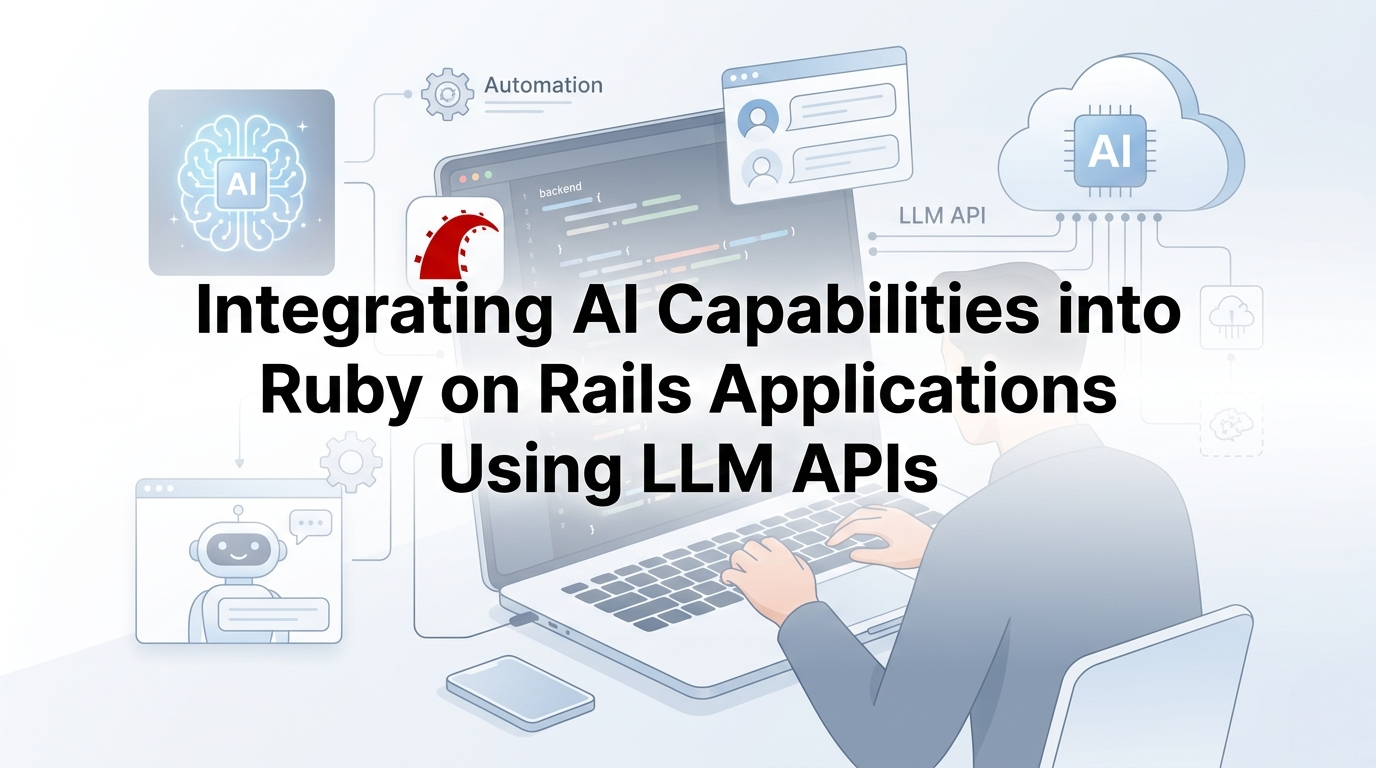
Artificial Intelligence is becoming a core component of modern web applications. From automating workflows to enhancing user interactions, AI enables businesses to build smarter and more efficient systems. One of the most practical ways to integrate AI today is through Large Language Model (LLM) APIs, which provide capabilities such as text generation, summarization, and conversational interfaces.
Ruby on Rails, known for its rapid development and structured architecture, allows developers to integrate these AI capabilities efficiently. By combining Rails with LLM APIs, businesses can build scalable applications with intelligent features without investing in complex machine learning infrastructure.
Understanding LLM APIs in Application Development
Large Language Models are trained on vast datasets and can process and generate human-like text. Through APIs, these models can be integrated directly into applications, enabling advanced features without requiring in-house AI development.
LLM APIs allow applications to:
- Generate contextual and human-like responses
- Understand user queries and intent
- Summarize large volumes of content
- Enable conversational interfaces
This makes them highly valuable for applications that require automation, interaction, and data-driven functionality.
Why Ruby on Rails is Suitable for AI Integration
Ruby on Rails provides a strong foundation for integrating external services like AI APIs due to its simplicity and flexibility.
Flexible API Integration
Rails supports seamless integration with external services, making it easier to implement AI functionalities within existing systems. Businesses leveraging Ruby on Rails API Development Services can efficiently connect their applications with LLM APIs while maintaining clean and scalable architecture.
Structured and Maintainable Code
Rails promotes a clean code structure, allowing AI logic to be implemented through service layers. This ensures better organization and long-term maintainability.
Rapid Development and Deployment
Rails enables faster development cycles, allowing businesses to implement AI features quickly and bring them to market without delays.
Practical Use Cases of AI in Rails Applications
Integrating LLM APIs into Rails applications enables multiple advanced use cases that enhance functionality and user experience.
Conversational Systems
AI-powered chat systems can handle user queries, automate responses, and provide real-time assistance. These systems improve engagement while reducing manual support efforts.
Content Automation
Applications can generate blogs, summaries, or dynamic content automatically, reducing the need for manual content creation and improving efficiency.
Intelligent Search
AI enhances search functionality by understanding user intent and delivering more relevant results, improving overall user experience.
Process Automation
AI can automate repetitive tasks such as data processing, report generation, and user interaction workflows, increasing operational efficiency.
Implementing LLM APIs in Ruby on Rails
Integrating AI into a Rails application requires a structured approach to maintain performance and scalability.
API Communication
Rails applications can communicate with LLM APIs using HTTP clients. This allows sending user input and receiving AI-generated responses.
require 'net/http'
require 'json'

uri = URI("https://api.example.com/v1/ai")

response = Net::HTTP.post(
  uri,
  {
    prompt: "Generate response"
  }.to_json,
  {
    "Content-Type" => "application/json"
  }
)

result = JSON.parse(response.body)

puts result
Service Layer Implementation
To maintain clean architecture, API interactions should be handled through a service layer.
class AiService
  def self.generate_response(input)
    # API logic
  end
end
This approach keeps controllers lightweight and improves code maintainability.
Application Integration
AI responses can be integrated into controllers, dashboards, or background jobs depending on the use case. This ensures smooth interaction between user input and AI-generated output.
Organizations often rely on an experienced ruby on rails development team to implement such integrations efficiently while maintaining performance and scalability.
Performance Optimization for AI Features
AI integration must be optimized to ensure application performance is not affected.
Key strategies include:
- Processing AI tasks in background jobs
- Caching frequently generated responses
- Reducing unnecessary API calls
- Monitoring API latency and response times
These practices help maintain speed and stability even with increased usage.
Data Handling and Security
When working with AI APIs, secure data handling is essential.
Important considerations:
- Avoid sending sensitive information to external APIs
- Use secure authentication methods
- Ensure encrypted communication
- Follow data privacy standards
Proper data management ensures compliance and builds trust with users.
Scaling AI-Enabled Rails Applications
As applications grow, AI features must scale efficiently to handle increasing demand.
Key strategies:
- Use distributed background processing
- Optimize database queries
- Implement caching mechanisms
- Continuously monitor system performance
A scalable setup ensures consistent performance and reliability.
Conclusion
Integrating AI capabilities into Ruby on Rails applications using LLM APIs enables businesses to build intelligent, scalable, and efficient systems. By leveraging external AI services, developers can add advanced functionality without complex infrastructure.
With the right architecture, performance optimization, and strategic implementation, AI integration can significantly enhance user experience and operational efficiency, helping businesses stay competitive in an evolving digital landscape. If you are planning to integrate AI into your application, contact W3villa Technologies to discuss your requirements and get expert guidance tailored to your business needs.