AI Overview
Observability in Ruby on Rails focuses on tracking, analyzing, and optimizing application performance using monitoring, logging, and scaling techniques. It helps detect issues early, improve reliability, and maintain system performance as applications grow.
Introduction: Why Observability Matters in Rails Applications
As Ruby on Rails applications grow, maintaining visibility into system behavior becomes challenging. Performance issues, unexpected errors, and scaling bottlenecks often go unnoticed until they impact users.
Observability solves this problem by helping teams track, analyze, and optimize application performance in real time. With the support of ror development services, businesses can build systems that are not only functional but also measurable and reliable.
In practical terms, observability helps teams:
- Identify performance bottlenecks early
- Detect and resolve errors faster
- Make informed scaling decisions
Without proper observability, even well-built applications can struggle under real-world conditions.
Monitoring Systems: Measuring Performance in Real Time
Monitoring is the foundation of observability. It provides continuous insights into how your Rails application is performing across different layers.
A well-configured monitoring system ensures that developers can quickly detect anomalies and respond before they escalate into major issues.
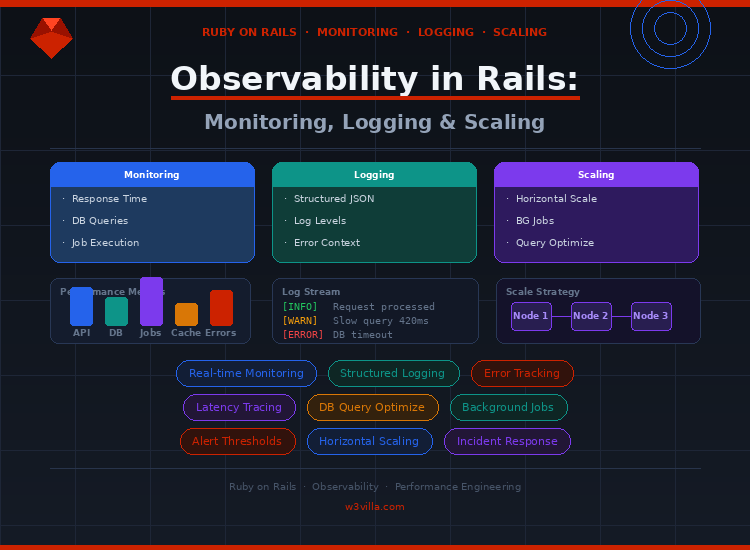
What to Monitor in Rails Applications:
- Request response time and throughput
- Database query performance
- Background job execution time
Monitoring helps answer critical questions like: Is the system slowing down? Which endpoint is causing delays? Where is the load increasing?
For example, if a specific API endpoint starts taking longer to respond, monitoring tools can highlight it instantly, allowing teams to take corrective action.
Logging Strategy: Turning Data into Debugging Power
Logs act as a detailed record of everything happening inside the application. However, without a proper structure, logs can become overwhelming and difficult to use.
A strong logging strategy ensures that logs are clear, searchable, and meaningful. Experienced ruby on rails experts design logging systems that provide actionable insights instead of noise.
Key Elements of Effective Logging:
- Structured logs (JSON format)
- Clear log levels (info, warning, error)
- Context-rich error messages
With proper logging, developers can trace issues step by step and understand exactly what went wrong.
For instance, when an error occurs in a payment flow, logs can show the request path, parameters, and failure point, making debugging faster and more precise.
Metrics and Tracing: Understanding System Behavior
Observability goes beyond logs and monitoring by introducing metrics and tracing. These tools help connect different parts of the system and provide a complete picture of application behavior.
Metrics provide numerical insights, while tracing shows how requests move across components.
Important Observability Signals:
- Latency and response time trends
- Error rates and failure patterns
- Request flow across services
This combination helps teams understand not just what failed, but why it failed.
In complex systems, tracing becomes especially useful in identifying where delays or breakdowns occur across multiple services.
Scaling Rails Applications with Observability Insights
Scaling is not just about adding more servers — it's about making data driven decisions. Observability plays a crucial role in identifying when and how to scale.
A reliable ruby on rails consulting company focuses on using observability data to guide scaling strategies.
Common Scaling Approaches:
- Horizontal scaling using multiple instances
- Offloading heavy tasks to background jobs
- Optimizing database queries and indexing
Observability helps determine which part of the system needs scaling and ensures that resources are used efficiently.
For example, if database queries are causing slowdowns, scaling the application alone won't help — query optimization becomes necessary.
Error Detection and Incident Management
One of the most valuable aspects of observability is proactive error detection. Instead of relying on user complaints, systems can automatically identify and report issues.
This reduces downtime and improves overall reliability.
Effective Error Handling Includes:
- Real-time alerts for critical failures
- Centralized error tracking systems
- Automated notifications for teams
When an issue occurs, developers receive immediate insights, allowing them to respond quickly and minimize impact.
Implementation Strategy: Building Observability into Rails
Observability should not be an afterthought. It needs to be integrated into the system from the beginning to ensure long term effectiveness.
Practical Steps for Implementation:
- Define key performance metrics
- Set up monitoring and logging tools
- Implement structured logging
- Configure alerts and thresholds
With proper ror development services, observability becomes a core part of the application architecture rather than an add on feature.
Real World Impact of Observability
Observability is widely used across applications where performance and reliability are critical.
It helps teams maintain system stability, improve user experience, and make informed decisions based on real data.
Where Observability Adds Value:
- High-traffic applications requiring performance tracking
- Systems handling critical transactions
- Platforms needing continuous optimization
Companies like W3Villa Technologies use observability-driven approaches to build scalable and reliable Rails applications.
Benefits of Observability in Rails
Observability enhances both development and operational efficiency, making systems easier to manage and scale.
Key Benefits:
- Faster debugging and issue resolution
- Improved system performance
- Better scalability planning
- Enhanced user experience
With strong rails development services, these benefits can be achieved without adding unnecessary complexity.
Conclusion
Observability in Rails allows teams to track, analyze, and optimize application performance with confidence. By combining monitoring, logging, and scaling strategies, systems become more reliable and easier to manage. Contact us to build observability-driven Rails applications that are ready for performance, stability, and growth.