AI OVERVIEW
In 2026, scaling React and Ruby on Rails together requires more than clean APIs—it demands tight coordination between frontend state management and backend SQL consistency. High-performing systems align React state, background jobs, and database transactions to avoid data drift, race conditions, and performance bottlenecks. Experienced Ruby on Rails experts and a mature Ruby on Rails development team design systems where state changes are predictable, traceable, and resilient, even at enterprise scale and in AI-driven applications.
Introduction
Modern applications are no longer simple request-response systems. In 2026, most products rely on React for dynamic interfaces and Ruby on Rails for business logic, data integrity, and APIs. As traffic grows, teams face a recurring challenge: keeping frontend state and backend SQL data perfectly aligned.
Without careful coordination, applications suffer from stale UI states, inconsistent data, and hard-to-debug production issues. This is a common scaling problem addressed daily by seasoned Ruby on Rails programmers and enterprise teams. This blog explores how state management meets SQL, and how React and Rails can work together reliably at scale.
What Is “State Management Meets SQL”?
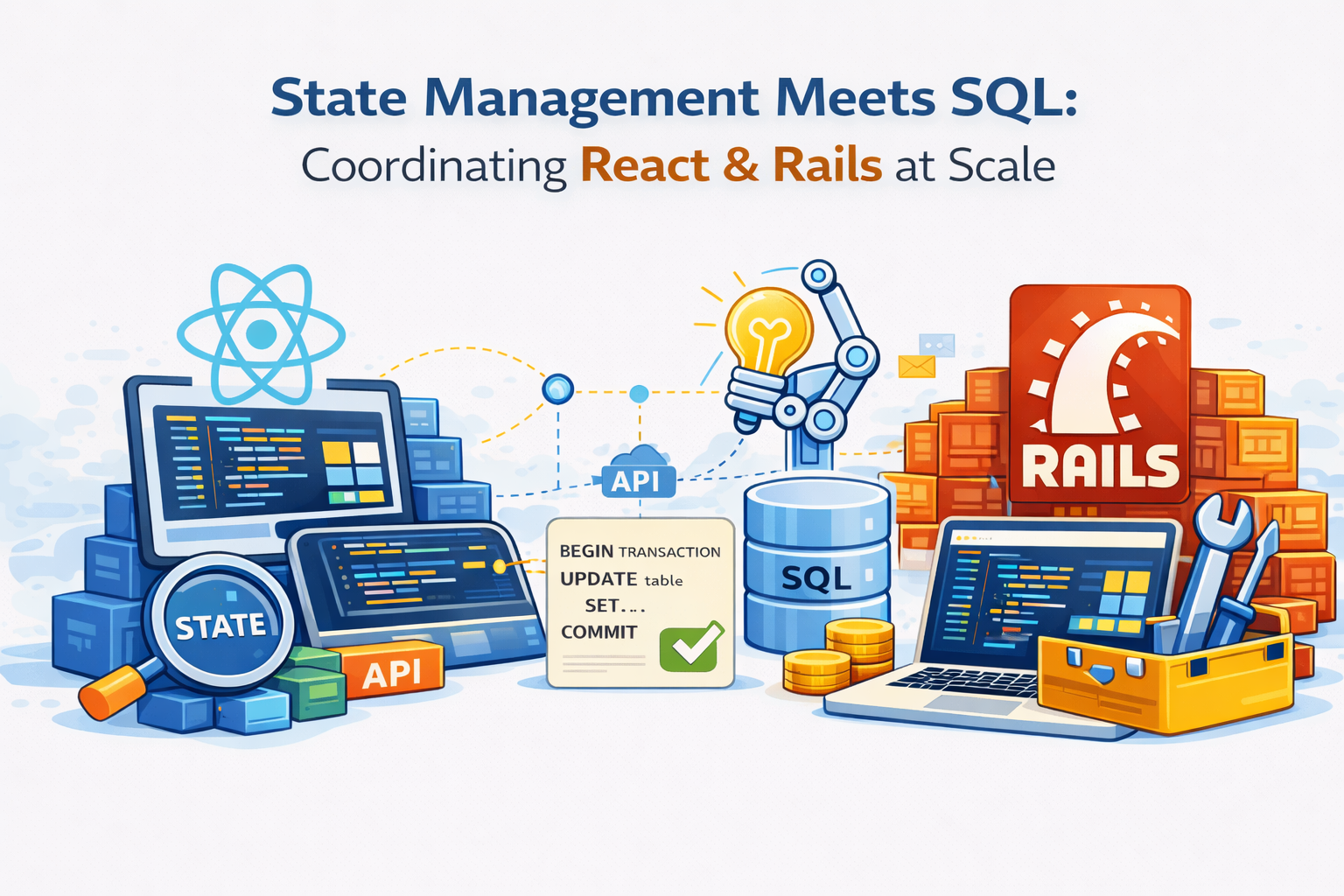
At scale, state management is not just a frontend concern. It represents the synchronization of UI state, backend business logic, and database transactions.
In a React + Rails system, this involves:
- Client-side state (React state, stores)
- Server-side state (Rails controllers, services)
- Persistent state (SQL databases)
- Asynchronous state (background jobs, events)
Leading Ruby on Rails consulting companies treat state consistency as a system-level responsibility rather than a frontend or backend problem alone.
Why State Coordination Is Important in 2026
As systems grow more interactive and AI-driven, state mismatches become costly.
Key reasons this matters today:
- Real-time interfaces demand instant state updates
- Background jobs delay database writes
- AI workflows introduce async decision-making
- Users expect consistent data across devices
- Data integrity directly impacts trust and revenue
This is why modern Ruby on Rails development teams invest heavily in predictable state-to-SQL coordination.
React State Management Challenges at Scale
While React applications manage state primarily on the client side, scalability challenges emerge as multiple users, concurrent sessions, and asynchronous updates interact within the system. At scale, applications often encounter issues such as stale UI state following backend changes, race conditions caused by simultaneous requests, inefficient data fetching patterns, and increasingly complex global state logic. These challenges frequently result in user interfaces that do not accurately reflect the current state of the database. For this reason, senior Ruby on Rails experts design backend systems with the assumption that frontend state is inherently temporary and must always be validated and reconciled against server-side data.
SQL as the Source of Truth in Rails
SQL remains the ultimate source of truth.
- Transactional consistency
- Validation rules
- Authorization logic
- Data lifecycle guarantees
Rather than trusting frontend state, experienced Ruby on Rails programmers design APIs that always reconcile UI intent with database reality.
Latest Trends & Innovations in React–Rails Coordination
- API-driven state reconciliation
- Event-based UI updates
- Optimistic UI with server verification
- Background job-aware frontend refresh
- AI-assisted state prediction
These patterns are increasingly important in products offering artificial intelligence services.
Optimistic UI with Server-Side Validation
- Immediate UI updates
- Server-side validation rollback support
- Clear error reconciliation paths
- Idempotent backend operations
This approach is widely used by Ruby on Rails solutions for startups building fast, user-centric products.
Managing Async State with Background Jobs
- Job status endpoints
- Polling or subscription-based updates
- State versioning
- Clear UI loading states
A mature Ruby on Rails development team designs background processing with frontend visibility in mind.
State Management in AI-Driven Rails Applications
- Log AI decision states
- Persist inference metadata
- Separate AI results from core transactions
- Communicate uncertainty to the UI
This is especially important for teams offering artificial intelligence services through Rails backends.
Benefits of Proper State–SQL Coordination
- Fewer production bugs
- Improved user trust
- Faster debugging and recovery
- Predictable system behavior
- Easier scaling across teams
This is why growing companies rely on expert Ruby on Rails consulting companies.
Common Mistakes to Avoid
- Trusting frontend state blindly
- Overloading APIs with UI logic
- Ignoring background job timing
- Mixing domain logic into React components
- Treating SQL as an implementation detail
Avoiding these mistakes is critical for Ruby on Rails MVP development at scale.
Expert Tips & Best Practices
- Treat SQL as the source of truth
- Design APIs for reconciliation, not perfection
- Keep frontend state disposable
- Log state transitions clearly
- Review incidents as system lessons
Conclusion: Designing for Consistency, Not Convenience
In 2026, scalable applications are built on intentional coordination between frontend state and backend data, not assumptions. React delivers fast, interactive experiences, while Rails and SQL enforce business truth and consistency. When designed correctly, these layers complement each other rather than compete. Partnering with experienced Ruby on Rails experts and a proven Ruby on Rails consulting company like W3villa Technologies enables startups and enterprises to build resilient, AI-ready systems where state, data, and user experience remain aligned as products scale.
Frequently Asked Questions (FAQs)
1. Should React state always mirror database state?
No. Frontend state should be treated as temporary and reconciled with SQL regularly.
2. How do Rails background jobs affect frontend state?
They introduce delayed changes that require UI awareness and refresh strategies.
3. Is optimistic UI safe for large applications?
Yes, when combined with server-side validation and rollback mechanisms.
4. How does AI impact state management?
AI introduces async and probabilistic states that must be logged and versioned.
5. Do Ruby on Rails consulting companies handle React integration?
Yes. Many provide full-stack architecture, state coordination, and scaling support.