AI Overview
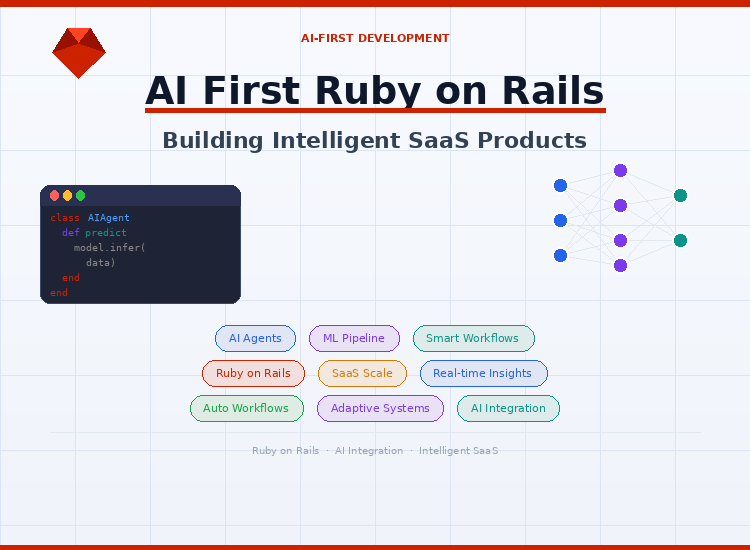
AI first Ruby on Rails focuses on building SaaS applications that learn from data, adapt to users, and automate decisions. By combining Rails architecture with intelligent integrations, businesses can create scalable and intelligent digital products.
SaaS products are evolving from simple tools into intelligent systems that support decision making. Earlier, applications only responded to user input, but now they are expected to anticipate needs and automate actions.
With ror development services, Ruby on Rails is being used to build applications that move beyond static workflows. Companies like W3Villa Technologies are creating systems that continuously analyze user behavior and improve over time, making SaaS platforms more adaptive and personalized.
For example, instead of manually filtering reports, a modern dashboard can automatically highlight key insights based on user activity.
Rails as the Backbone of Intelligent SaaS
Ruby on Rails plays a central role in AI first applications by acting as the system that connects data, logic, and intelligence. It ensures that AI is not just an external feature but an integrated part of the product.
A well designed Rails architecture supports smooth data flow and efficient background processing, making it easier to embed intelligent features without affecting performance. This is where experienced ruby on rails experts bring strategic value.
In practice, Rails manages:
- Structured data and validation
- Communication with AI services
- Execution of workflows based on insights
For instance, in an e-commerce SaaS product, AI may predict user preferences, but Rails determines how those predictions influence recommendations, pricing, or interface changes.
Designing SaaS That Learns from Users
The most important transformation in AI first systems is the ability to learn continuously. Traditional applications follow fixed logic, while intelligent systems evolve with every interaction.
At a fundamental level, the difference can be understood like this:
Traditional SaaS:
Input → Process → Output
AI first SaaS:
Input → Learn → Adapt → Predict → Act
This loop changes everything.
Instead of static flows, applications become dynamic systems that improve automatically as more data is collected. Rails supports this evolution by managing structured data and enabling seamless integration with AI services.
Where AI Fits into Rails Architecture
AI in a Rails application operates across multiple layers rather than existing as a single component. Understanding this helps in building scalable and maintainable systems.
At a high level, AI contributes to:
- Interpreting user inputs and behavior
- Generating predictions or classifications
- Triggering intelligent system actions
Rails acts as the coordinator between these layers, ensuring that insights are translated into meaningful outcomes.
For example, in a customer support platform, AI can analyze incoming queries to determine urgency or intent. Based on this, Rails automatically routes the request to the appropriate workflow, reducing response time and improving efficiency.
A structured approach by a ruby on rails consulting company ensures that these integrations remain clean and scalable.
Maintaining Performance While Adding Intelligence
Introducing AI into SaaS systems can increase complexity, especially when it comes to performance. If not managed properly, it can slow down applications and affect user experience.
Rails addresses this challenge by enabling asynchronous processing and efficient resource management. Instead of executing all operations in real time, heavy tasks can be handled in the background.
To maintain balance between performance and intelligence:
- AI tasks are processed using background jobs
- Frequently used results are cached
- API calls are optimized and controlled
For example, recommendation engines can run in the background and store results, allowing users to experience instant responses without delays.
Real World Applications of AI First Rails SaaS
AI first Rails applications are already transforming multiple industries by combining structured backend systems with intelligent decision making.
In CRM platforms, systems analyze customer behavior and suggest actions that improve conversion rates.
In e-commerce platforms, user activity is used to deliver personalized product recommendations and dynamic pricing strategies.
Healthcare systems leverage AI for analyzing patient data and predicting risks, while Rails ensures secure and organized data handling.
EdTech platforms use adaptive learning models to customize content based on student performance, improving engagement and outcomes.
Across all these use cases, Rails acts as the backbone that connects intelligence with execution.
Avoiding Common Pitfalls in AI SaaS Development
While AI offers significant advantages, its implementation requires careful planning. Many systems fail because intelligence is added without a clear purpose.
Some common challenges include:
- Lack of a defined use case for AI
- Poor data quality affecting predictions
- Overcomplicating system architecture
A more effective approach is to start with a focused problem and gradually expand. Businesses should prioritize real user needs and ensure that the system remains scalable.
Working with ruby on rails experts helps maintain a balance between innovation and stability.
Conclusion
AI first development is turning SaaS into systems that learn, adapt, and improve continuously. It's not just about adding features — it's about changing how software behaves.
Ruby on Rails supports this shift with a structured and flexible foundation, making it easier to build intelligent, scalable applications.
The real value lies in creating products that don't just respond, but continuously evolve and make smarter decisions over time.
Contact us to explore how intelligent SaaS solutions can be built for your business.
FAQs
What is AI first Ruby on Rails?
It is an approach where intelligence is built into Rails applications from the start, enabling systems to learn and automate decisions.
How does AI improve SaaS products?
AI helps SaaS platforms analyze data, predict outcomes, and automate workflows for better efficiency.
Can Rails handle intelligent SaaS systems?
Yes, Rails provides a strong backend to manage data, workflows, and AI integrations effectively.
Is AI integration complex in Rails?
No, it can be implemented using APIs and background processing without major complexity.
What makes AI first SaaS different?
AI first SaaS adapts and improves continuously instead of following fixed logic.