AI Overview
Artificial Intelligence will be a key driver of programming trends from 2025 to 2030, enabling smarter, data-driven applications. Python will continue to lead in AI development, while other languages adapt to support intelligent systems.
For businesses, adopting AI is essential to improve efficiency, innovation, and long-term competitiveness.
Introduction
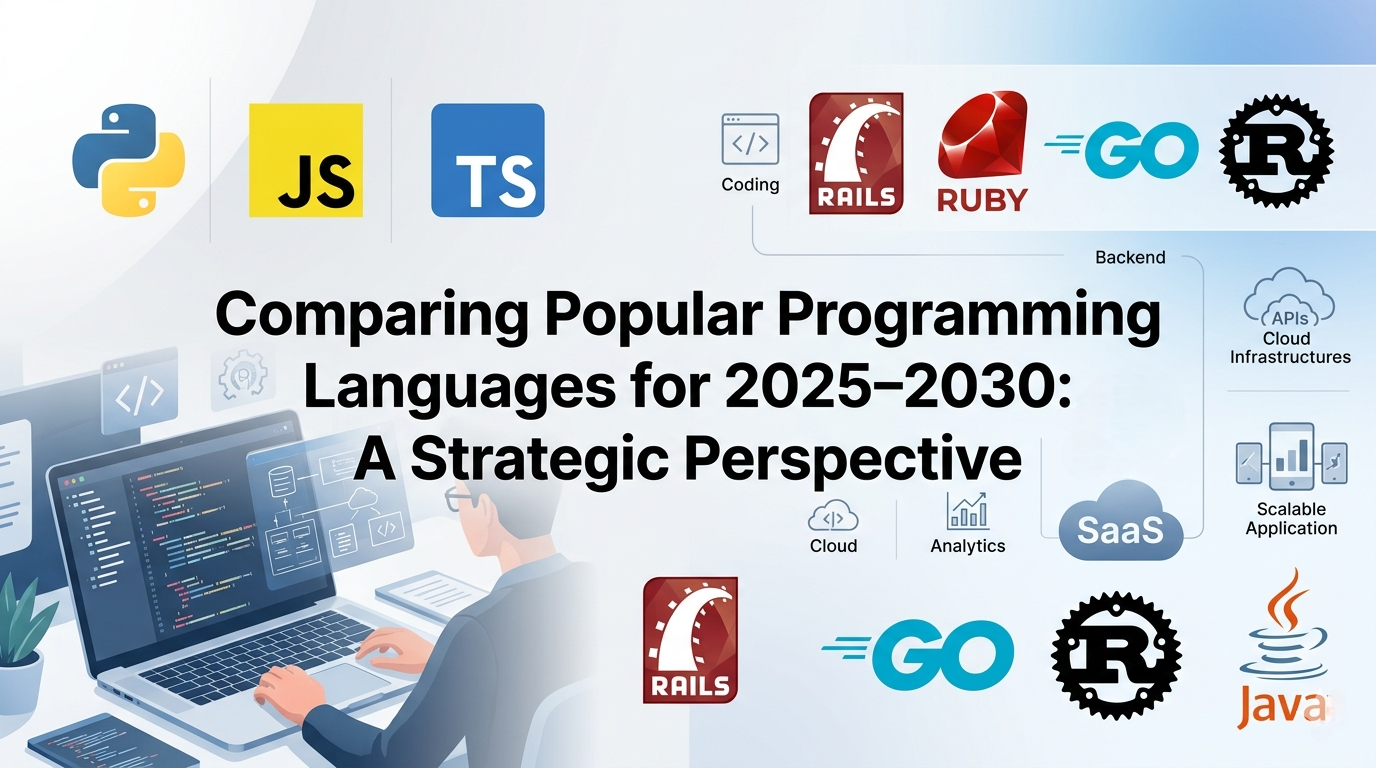
The rapid evolution of software development is transforming how businesses build and scale digital products. Between 2025 and 2030, programming languages will play a critical role in determining development speed, system performance, maintainability, and scalability.
W3villa Technologies focuses on helping businesses choose the right technology stack for long-term success. Selecting the appropriate programming language is a strategic decision that directly impacts scalability and performance. This article provides a technical comparison of leading programming languages to support informed and future-ready development decisions.
Key Factors for Evaluating Programming Languages
To make an effective decision, programming languages should be evaluated on the following technical parameters:
- Execution Performance: Runtime speed, memory usage, and concurrency handling
- Scalability: Ability to support high traffic and distributed systems
- Ecosystem & Tooling: Availability of frameworks, libraries, and developer tools
- Maintainability: Code readability, structure, and long-term support
- Learning Curve & Talent Availability: Ease of hiring and onboarding developers
Leading Programming Languages for 2025–2030
Python: Data-Driven and AI-Centric Development
Python is widely adopted for its simplicity and strong ecosystem in data science and artificial intelligence. It supports rapid prototyping and integrates well with advanced computational libraries.
- Strengths: Extensive libraries, fast development cycles
- Limitations: Slower execution compared to compiled languages
- Best suited for: AI systems, analytics platforms, automation tools
JavaScript and TypeScript: Full-Stack Web Ecosystem
JavaScript remains the backbone of web development, while TypeScript enhances large-scale application reliability through static typing.
- Strengths: Cross-platform development, strong ecosystem
- Limitations: Complexity in large-scale unstructured codebases (mitigated by TypeScript)
- Best suited for: Web applications, SaaS platforms, real-time systems
Ruby on Rails: Rapid Development with Structured Architecture
Ruby on Rails emphasizes convention over configuration, allowing faster development with clean and maintainable code. Businesses often rely on experienced Ruby on Rails programmers to accelerate product delivery without compromising quality.
- Strengths: High productivity, clean code structure
- Limitations: Performance constraints in highly compute-intensive applications
- Best suited for: MVPs, SaaS products, content-driven platforms
Go (Golang): High-Performance Backend Systems
Go is designed for efficiency and scalability, particularly in distributed systems and cloud-native environments.
- Strengths: Concurrency support, low memory overhead
- Limitations: Limited abstraction compared to higher-level languages
- Best suited for: Microservices, APIs, cloud infrastructure
Rust: Memory Safety and Performance Optimization
Rust offers a unique combination of performance and safety by eliminating common memory errors without a garbage collector.
- Strengths: High performance, strong safety guarantees
- Limitations: Steeper learning curve
- Best suited for: System-level programming, performance-critical applications
Java: Enterprise-Grade Stability
Java continues to be a preferred choice for enterprise-level applications due to its robustness and scalability.
- Strengths: Platform independence, mature ecosystem
- Limitations: Verbose syntax
- Best suited for: Enterprise systems, large-scale backend applications
Comparative Overview
Below is a detailed technical comparison of the leading programming languages based on critical engineering parameters:
| Language | Execution Model | Performance Level | Scalability | Concurrency Support | Ecosystem Maturity | Typical Use Cases |
|---|---|---|---|---|---|---|
| Python | Interpreted | Moderate | High | Limited (GIL bound) | Very Mature | AI/ML, Data Science, Automation |
| JavaScript | Interpreted (JIT) | Moderate | High | Event-driven | Very Mature | Web Apps, Real-time Systems |
| TypeScript | Transpiled (JS) | Moderate | High | Event-driven | Mature | Large-scale Web Applications |
| Ruby on Rails | Interpreted | Moderate | Medium | Limited | Mature | Web Apps, SaaS, MVPs |
| Go | Compiled | High | Very High | Native Goroutines | Growing | Cloud, Microservices, APIs |
| Rust | Compiled | Very High | High | Advanced (Safe) | Growing | Systems, Game Engines, Blockchain |
| Java | Compiled (JVM) | High | Very High | Multi-threading | Very Mature | Enterprise Applications |
Insights:
- Compiled languages like Go and Rust offer superior runtime performance compared to interpreted languages.
- Concurrency models vary significantly: Go uses goroutines, while Java relies on multi-threading, and JavaScript uses an event-driven approach.
- Scalability is strongest in Go and Java due to their architecture and runtime efficiency.
- Developer productivity is higher in Python and Ruby on Rails due to simpler syntax and conventions.
Industry Trends Shaping 2025–2030
AI and Data-Centric Development
Python will remain dominant due to its unmatched capabilities in machine learning and analytics.
Cloud-Native Architecture
Go is expected to lead in backend and infrastructure development as microservices continue to grow.
Structured and Scalable Web Development
TypeScript adoption will increase as organizations prioritize maintainability in large codebases.
Performance and Security Focus
Rust will gain traction in environments where reliability and efficiency are critical.
Conclusion
The programming landscape from 2025 to 2030 will be driven by specialization, with each language serving a specific purpose from AI and web development to cloud computing and high-performance systems.
For businesses aiming to build scalable and reliable applications, choosing the right technology stack is crucial. Professional RoR development services can help streamline development while maintaining quality and efficiency.
For expert guidance and tailored solutions, you can connect with W3villa Technologies to discuss your project requirements.