AI OVERVIEW
In 2026, enterprise platforms continue to rely on Ruby on Rails monoliths because they provide superior development velocity, architectural clarity, and operational stability compared to over-fragmented microservice ecosystems. When designed by an experienced Ruby on Rails development team, modern monoliths scale efficiently through modular architecture, asynchronous processing, multi-database strategies, and cloud-native infrastructure. This is why Ruby on Rails experts and leading Ruby on Rails consulting companies still recommend monolith-first strategies—even for AI-driven, high-traffic systems integrated with Google ADK development services.
Introduction
For nearly a decade, the software industry has treated microservices as the inevitable destination for any “serious” system. Yet in 2026, reality tells a different story.
Large-scale platforms—handling millions of users, complex business logic, AI workflows, and compliance-heavy domains—are increasingly doubling down on Rails monoliths, not abandoning them.
The reason is simple: scale is no longer the hardest problem—coordination is. Distributed systems introduce organizational and operational complexity that most teams underestimate. A modern Ruby on Rails monolith, architected by senior Ruby on Rails programmers, delivers scalability without sacrificing speed, reliability, or developer sanity.
This article explains why monoliths remain the preferred choice for large systems, how Rails has evolved to support enterprise scale, and what architectural patterns define successful Rails platforms in 2026.
What Does “Rails Monolith” Really Mean in 2026?
Modern systems must support AI pipelines, regulatory compliance, real-time features, and rapid iteration—all at once.
Rails monoliths excel in this environment.
Key reasons enterprises still choose Rails monoliths:
- Faster decision-making across engineering teams
- Reduced cognitive load for developers
- Easier governance and security enforcement
- Predictable performance under complex workloads
- Seamless integration with AI and analytics layers
- Lower total cost of ownership over time
This is why an experienced Ruby on Rails consulting company often advises scaling within the monolith before introducing distributed services.
Why Rails Monoliths Matter More Than Ever in 2026
The pressures on modern systems have changed.
Today’s platforms must support:
- AI-assisted features
- Real-time user experiences
- Regulatory compliance
- Rapid experimentation
- Smaller, highly productive teams
Rails monoliths excel because they offer:
- Lower cognitive load for developers
- Faster cross-feature delivery
- Simpler security and compliance enforcement
- Stronger data consistency guarantees
- Reduced DevOps and observability overhead
For organizations hiring a Ruby on Rails development team, these factors directly translate into lower risk and faster ROI.
Rails at Enterprise Scale: Evolution Since 2020
Rails’ reputation as “not scalable” became outdated years ago.
By 2026, Rails supports enterprise-grade workloads through:
- Multi-database architectures (read replicas, sharding)
- Async query loading and background job orchestration
- Built-in caching strategies and CDN-first delivery
- Improved boot performance and memory efficiency
- Mature observability integrations
Experienced Ruby on Rails experts now treat scaling Rails as an architectural discipline—not a framework limitation.
Architectural Trends Defining Rails Monoliths in 2026
1. Domain-Centric Modularization
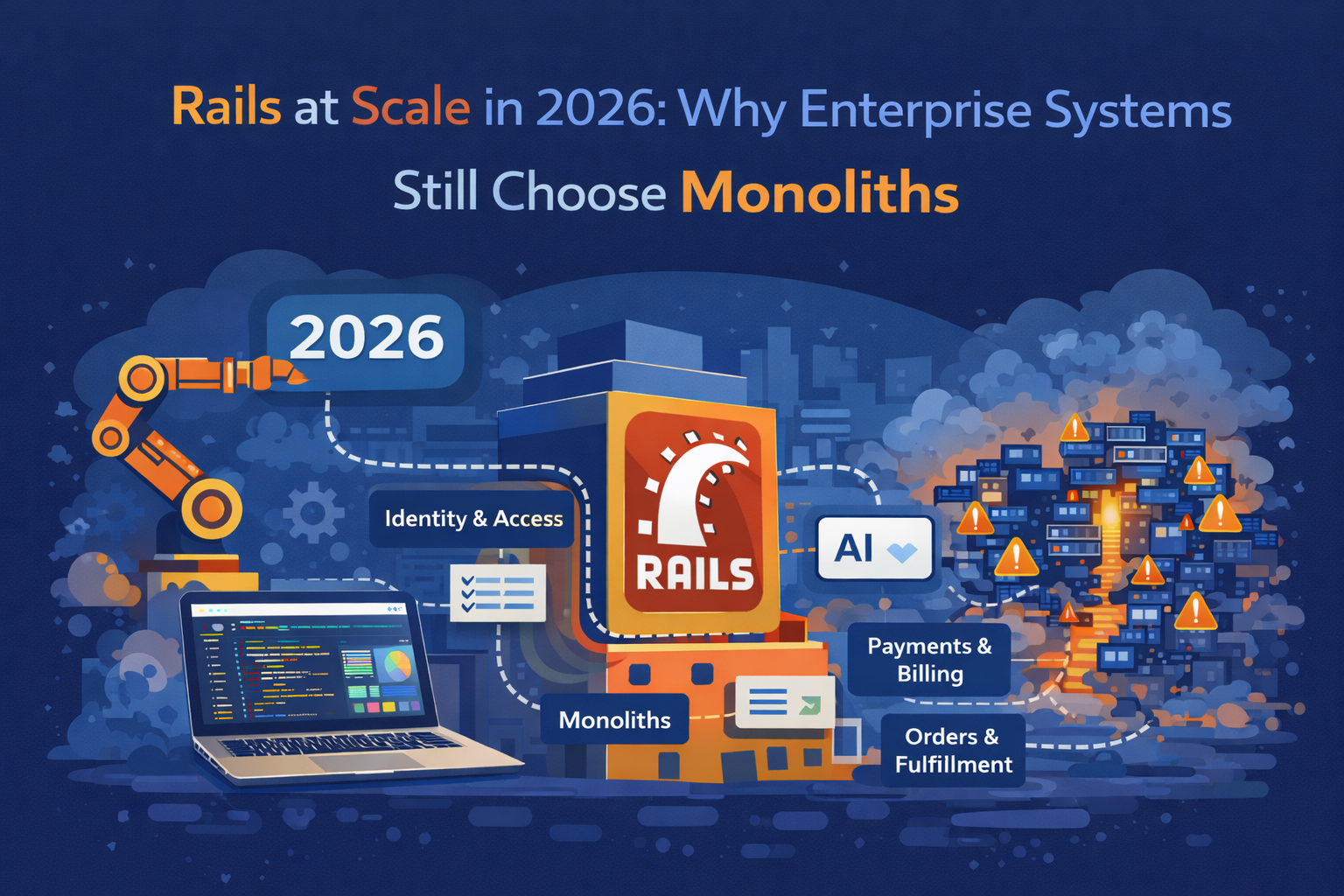
Instead of breaking systems into services, teams break them into business domains:
- Identity & Access
- Payments & Billing
- Orders & Fulfillment
- Analytics & Reporting
- AI Inference & Recommendations
Each domain is internally isolated, testable, and independently evolvable—without requiring separate deployments.
This approach is now standard practice among senior Ruby on Rails programmers.
2. AI-Native Rails Monoliths
Rails has quietly become a strong foundation for AI-driven products.
Modern Rails monoliths integrate:
- LLM orchestration layers
- Vector search and embeddings
- AI-assisted workflows
- Google ADK development services for model pipelines
Keeping AI logic inside a monolith reduces latency, simplifies experimentation, and avoids data synchronization issues common in microservices.
3. Event-Driven Architecture Inside the Monolith
Rails systems increasingly rely on internal events:
- Domain events
- Async job pipelines
- Pub/sub-style communication
This allows teams to achieve microservice-like decoupling without distributed system failure modes—a key reason monoliths remain dominant.
Business Benefits of Rails Monoliths
From a business perspective, Rails monoliths offer advantages that are difficult to ignore.
Key benefits include:
- Faster product iteration
- Lower infrastructure and staffing costs
- Reduced incident resolution time
- Easier onboarding of new engineers
- Better alignment between product and engineering
These outcomes are why enterprises continue partnering with Ruby on Rails consulting companies instead of chasing architectural trends.
Common Scaling Mistakes That Hurt Rails Projects
Rails does not fail at scale—teams fail to architect responsibly.
Common mistakes include:
- Premature microservice adoption
- Ignoring domain boundaries
- Overloaded ActiveRecord models
- Poor background job isolation
- Treating observability as optional
- Letting infrastructure decisions drive design
An experienced Ruby on Rails development team avoids these pitfalls through intentional system design.
Expert-Level Best Practices for Rails at Scale
Successful Rails platforms share consistent architectural principles.
Best practices used by Rails experts:
- Design around business capabilities, not frameworks
- Enforce domain ownership within the codebase
- Isolate write-heavy and read-heavy workflows
- Treat background jobs as first-class citizens
- Add tracing and metrics before performance issues arise
- Delay service extraction until organizational scale demands it
These patterns are proven across fintech, healthcare, SaaS, and AI platforms.
Monolith vs Microservices: The 2026 Decision Framework
Microservices are no longer the default—they are a specialized tool.
Rails monoliths are preferred when:
- Teams are small to mid-sized
- Features evolve rapidly
- Strong data consistency is required
- Operational simplicity matters
This is why most Ruby on Rails experts recommend starting with a monolith and extracting services only when clearly justified.
Who Should Still Choose Rails Monoliths?
Rails monoliths remain ideal for:
- SaaS and subscription platforms
- Fintech and healthtech systems
- AI-powered applications
- Marketplaces and B2B platforms
- Internal enterprise tools
When built by skilled Ruby on Rails programmers, these systems scale predictably and sustainably.
Conclusion: Rails Monoliths Are a Strategic Advantage in 2026
In 2026, the most successful software systems are not defined by how complex their architecture looks on paper, but by how intentionally they are designed to evolve over time. Rails monoliths continue to succeed at scale because they minimize unnecessary architectural and operational overhead, allow small and focused teams to operate with enterprise-level efficiency, support AI-native workloads without introducing avoidable system fragmentation, and adapt gracefully as business requirements, data volumes, and user expectations grow. Choosing to partner with an experienced Ruby on Rails development team or Ruby on Rails consulting company such as W3villa Technologies is not a legacy decision—it is a forward-looking strategy for organizations that prioritize long-term scalability, maintainability, and technical clarity over short-lived architectural trends.
FAQs
1. Is Ruby on Rails still relevant for large systems in 2026?
Yes. Rails is actively used for enterprise-scale platforms when designed by experienced Ruby on Rails experts.
2. Why are companies moving away from microservices?
Many organizations underestimated operational and organizational complexity, leading them back to modular monoliths.
3. Can Rails monoliths support AI workloads?
Absolutely. Rails integrates well with AI pipelines, vector databases, and Google ADK development services.
4. When should a Rails monolith be split into services?
Only when organizational scale, not traffic alone, justifies the added complexity.
5. What role do Ruby on Rails consulting companies play?
They provide architectural guidance, scaling strategies, and long-term maintainability for enterprise systems.